
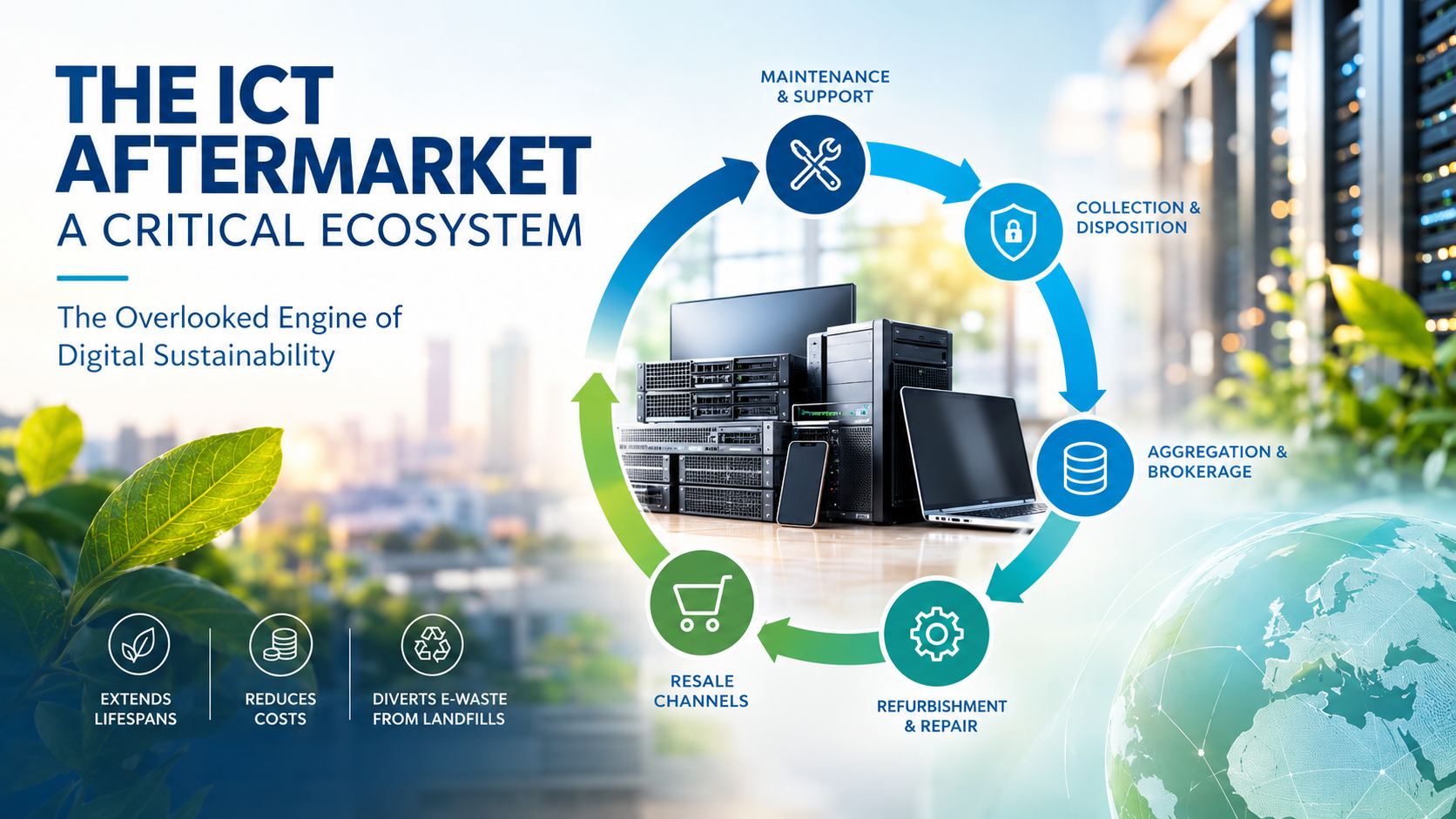
THE ICT AFTERMARKET: A CRITICAL ECOSYSTEM
The Overlooked Engine of Digital Sustainability
The ICT aftermarket is a multi-billion industry that is fragmented and less consistently measured than the primary equipment market. While original equipment manufacturers (OEMs) dominate headlines, independent providers quietly handle and manage millions of devices. This market is not merely a waste-management system; it is a strategic economic and environmental asset that extends equipment lifespans, reduces enterprise costs, and diverts electronic waste from landfills. The aftermarket also serves as a critical buffer when new-equipment supply chains are disrupted, allowing organizations to maintain operations without waiting for new hardware procurement.
Despite its scale (thousands of companies in Europe), the aftermarket remains underfunded in research, policy, and media coverage – a blind spot that obscures its role in the IT infrastructure for both circular economy goals, sovereignty, reducing OEM dependencies and enterprise resilience.
The Ecosystem—Key Actors & Value Chain
A Complex Network of Interdependent Players: The ICT aftermarket is distinguished by its fragmentation and interdependence. Unlike the OEM-dominated primary market with clear supplier-reseller hierarchies, the aftermarket consist of actors who simultaneously serve as buyers, sellers, competitors and partners. A better understanding of this ecosystem is essential for policymakers crafting circular economy regulations.
The ICT aftermarket encompasses three primary pillars:
Primary Focus
| Data centre equipment and enterprise software |
Key Asset Categories
Servers, storage systems, network hardware, ITAD, refurbishment, professional software
Market Positioning
Mature; drives 65% of aftermarket sales globally due to value of assets
Primary Focus
Devices used by organizations and individuals
Key Asset Categories
Laptops, desktops, monitors, smartphones, ITAD, refurbishment, consumer software
Market Positioning
Growing rapidly (9.68% CAGR); 35% of aftermarket sales; though highest volume segment
Primary Focus
Extended hardware and software support beyond OEM lifecycles
Key Asset Categories
TPM services, TPSM, data erasure
Market Positioning
Fast growing segment; 11-14% annual growth projected through 2028. High budget impact for end-users.
Note: Recycling is the last resort and seen as output of the market.
The refurbished and secondary IT market demonstrates robust growth potential, though precise aggregate figures remain fragmented. A key driver is the professionalised service of IT Asset Disposition (ITAD) Market: secure removal of no longer used hardware. The ITAD market covers both Enterprise ICT and End-User Computing.
Driven by data protection and security laws the market developed standards for processes beyond ISO and IEEE and software tools. Examples of these ITAD certifications are R2, ADISA and eStewards. Software tools that support the Certified Data Erasure are crucial to safely reuse assets, examples are Certus (European Software), Blancco and BitRaser.
The aftermarket operates as a sequential value chain, with each stage adding certification, quality assurance, or market access.
The Value Chain: From Maintenance and Support to Decommissioning to Remarketing
Key Actors
TPM providers, data erasure specialists, logistics partners
Functions
Extended maintenance beyond OEM lifecycles; data security; reverse logistics
Economic Value
Increasingly strategic for enterprises
Key Actors
ITAD providers
Functions
Deinstallation, secure transport, chain-of-custody, data sanitization, device selection
Economic Value
Critical gatekeeper; ensures regulatory compliance & data security
Key Actors
Brokers/wholesalers (declining segment; consolidating)
Functions
Bulk purchasing from corporates/ITAD; grading by specifications; inventory aggregation
Economic Value
Market liquidity function; shrinking due to vertical integration
Key Actors
Professional refurbishers
Functions
Functional testing, cosmetic restoration, component replacement, OS licensing, warranty provision
Economic Value
Value-add layer; transforms end-of-life assets into Grade A/B stock
Key Actors
Retailers, online marketplaces, system integrators, distributors
Functions
Final-mile customer reach; warranty management; logistics; customer support
Economic Value
Direct interface with end-users; critical for market legitimacy
Specialized Service Layers: Where Independent Value Is Created – Including Software
Third-Party Maintenance (TPM) Providers form a critical but underrecognized segment. Most large enterprises are now adopting TPM services, this market to supports longer usage and complements the purchasing of refurbished systems. TPM providers extend support 4 to 10 years beyond OEM lifecycles, a Gartner estimate shows delivering up to 70% cost savings compared to OEM contracts. In 2022, enterprise hardware maintenance generated reported USD 60 billion in total revenue; TPM captured 3.45% share but grew at 14.39% annually since 2015; outpacing the broader maintenance market.
Third-Party Software Maintenance (TPSM) is expanding rapidly as enterprises resist vendor lock-in. Providers extend support for legacy major software systems (ERP, databases, VMware, middleware) after vendor support ends, addressing a market pain point: rising software maintenance costs with increasingly restrictive vendor licensing models.
Used Software Resale (Europe only) allows organizations to resell Microsoft Office, enterprise applications, and other licensed software—a practice validated by European Court of Justice rulings. Pressured by vendors shifting to subscription and SaaS models as it applies under specific conditions: demands a perpetual licence and the first acquirer ceasing use of the copy. Also splitting of licence bundles/packages is not allowed.
E-Waste and Circularity as Market Driver
Over 62 million metric tons of electronic waste are generated globally annually, yet only 22% is reused or recycled effectively. The ICT aftermarket absorbs and redirects a significant portion of this waste stream, extending device lifecycles 3-5 additional years and avoiding the embodied carbon of new manufacturing.
Environmental Benefits of Refurbished IT:
- A refurbished laptop emits only 5 to 7% of the CO2 of a new device, avoiding the carbon cost of manufacturing.
- Refurbished data centre hardware saves an additional €400 – 800 per device in environmental externalities
- EU enterprises implementing circular procurement mandates (25–40% refurbished/recycled content) redirect capital savings toward digital transformation and cybersecurity
Conclusion: The Aftermarket as Strategic Infrastructure
The ICT aftermarket is no longer a niche or secondary concern. With combined services this is a solid channel with growth rates of 7–14% across subsegments. It represents a critical pillar of the global circular economy strategy. The ecosystem’s fragmentation is both its strength—enabling competition and innovation—and its weakness—limiting awareness and policy engagement.
For policy makers, recognizing the ICT aftermarket as strategic infrastructure for sustainability, cost efficiency, and digital sovereignty is essential. This market offers compelling narratives: how enterprises extend IT budgets through longer use and refurbishment; how independent technicians compete against OEM monopolies; how developing economies access technology affordably; and how circular practices reduce e-waste while creating jobs.
Future growth requires three priorities: (1) technical standardisation for refurbished assets, handling and processes, (2) regulatory frameworks that protect independent providers from OEM policies and (intellectual property) restrictions, and (3) circular procurement mandates that recognize longer use and demand refurbished and remanufactured assets to be part of the IT infrastructure.


